I am fascinated with absorbent grounds that are specifically suited for watercolors. The two grounds I am currently experimenting with are Golden Artist’s Absorbent Ground, which is more like a white gesso and Golden Artist’s Watercolor Ground, which is more like a hot-pressed watercolor paper. The experiment is ongoing. I will be applying Golden Artist’s QoR Watercolors to these surfaces in order to judge the results.
Blog
-
Direction
I’ve been fascinated by horror and science fiction all my life. The true horror and science fiction is the life lived less than expected. My artistic approach should be based on the melancholy moments that bring to my heart a feeling of pleasure.
-
QoR Watercolor Ground
The completion of the inking of the original graphite drawing is done. The next step is to reduce the intensity of the contrast back down to the graphite drawing. The overall reason for this, because the drawing was done on D’Arches 140 LB. CP., is to prepare for QoR Watercolor painting. Each step has been done to optimize this endgame with QoR Watercolors. It was just a natural result that the QoR Watercolor Ground would reduce the inked illustration back toward the original graphite drawing.
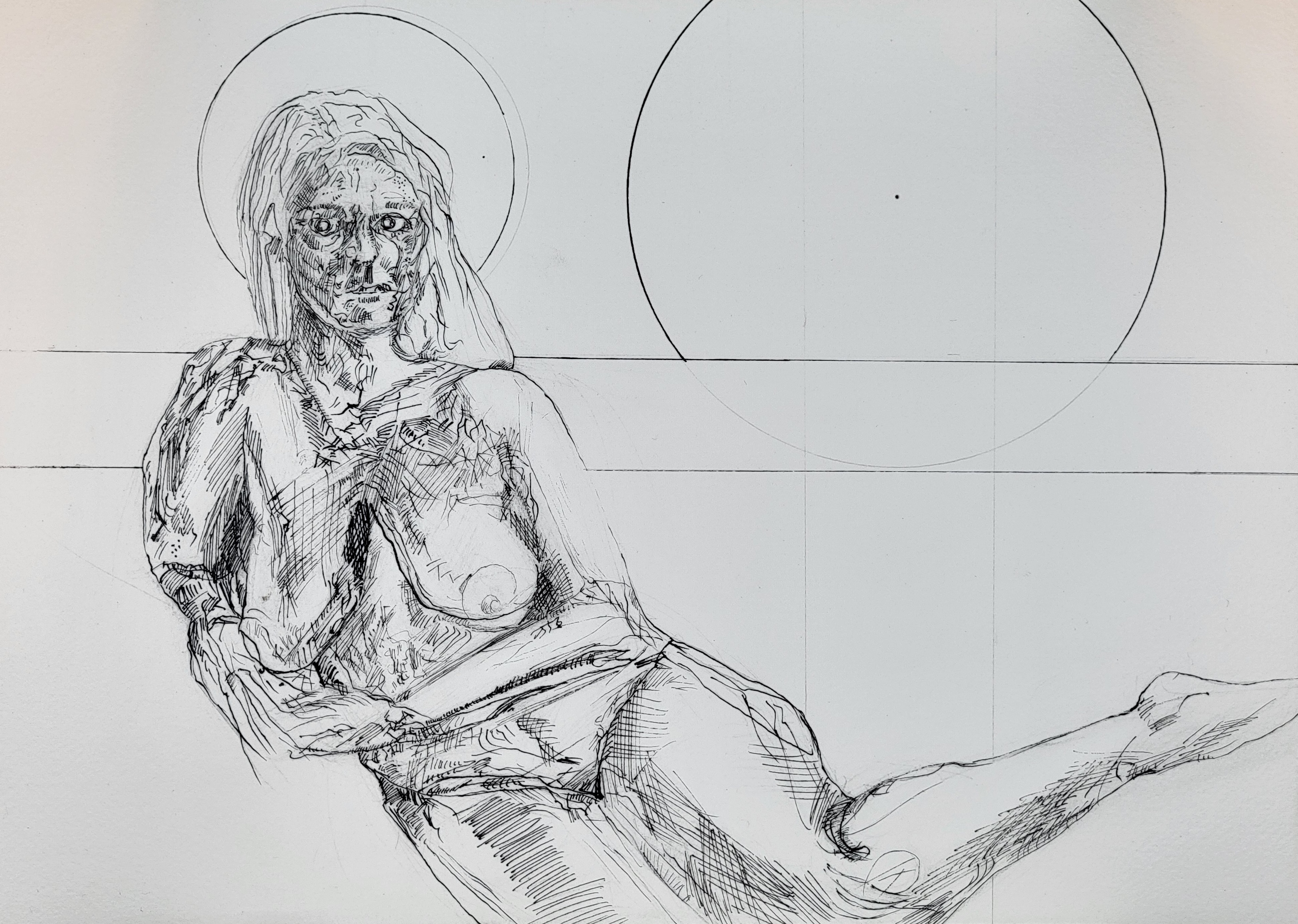
This is the image used for QoR Watercolors -
What Other Substrate?
Wondering what other substrates I can use with QoR Watercolor Ground and Golden Absorbant Ground? Stretched canvas, canvas board or MDF board are the typical choices. Sounds like a lot of experiments.
-
QoR Watercolor Inorganic Six Color Palette
This watercolor palette consists of just 6 colors. Venetian Red, Nickle Yellow, Chromium Oxide Green, Payne’s Gray, Payne’s Gray (Violet) [not pictured] and Titanium White. From these I will use the QoR mediums and grounds on mostly D’Arches 140 LB. CP. or rough.
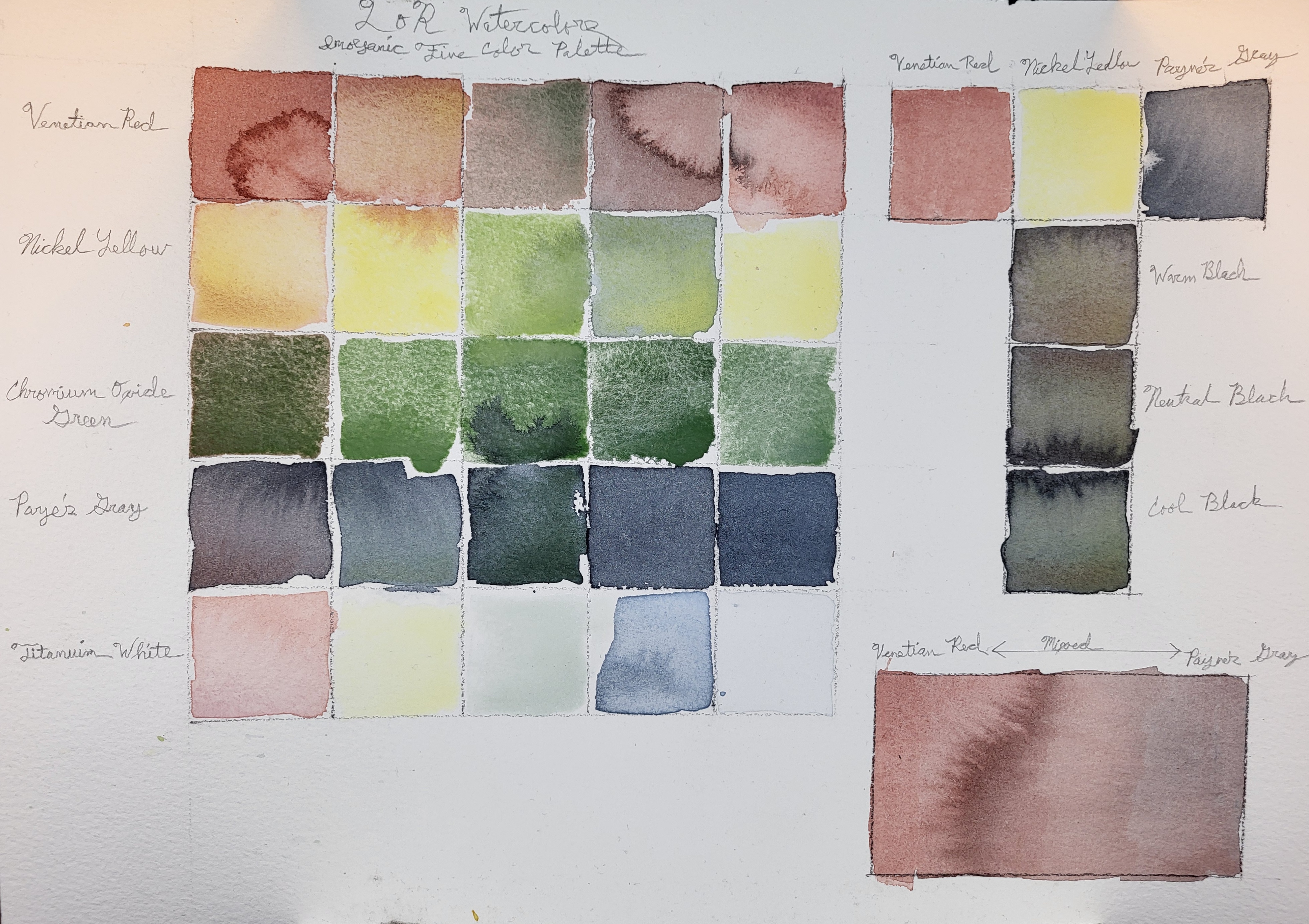
These are the 5 QoR colors I have chosen -
QoR Watercolor?
This project is a watercolor painting, but with the use of very modern tools and materials. The surface will be D’Arches 140LB.CP., with a graphite drawing on it. Next black acrylic ink will be applied to the drawing. This will be strong and overwhelming. Cover the black and white drawing with a coat of QoR Watercolor Ground. A faint image should remain peeking through. Use QoR Lift Aide to remove paint for compositional reasons. QoR Synthetic Ox Gall to bring addition wetting to the paints improving flow. I believe QoR Watercolor Medium will add richness to the paint. Finally, QoR Masking Fluid can aid in preserving the white of the paper after repeated applications of QOR Watercolor paint.
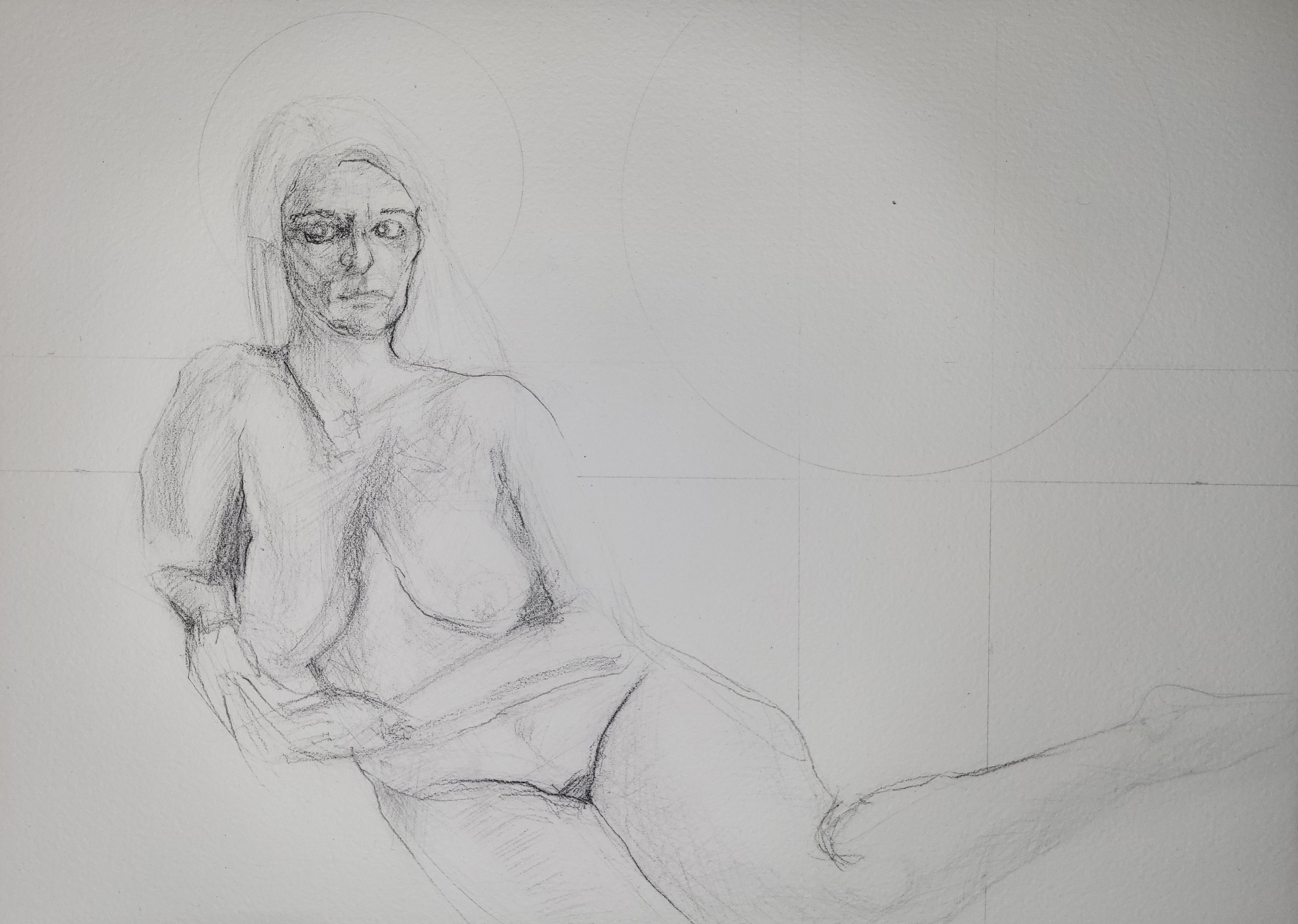
Source drawing -
Tuesday’s Life Study
Trying to figure out what medium I want to use. The choices are:
1. Charcoal
2. Watercolor
3. Hard Pastel
4. Graphite
5. Ink
6. Acrylic
There are a lot of thoughts and concerns for the medium to choose. I first was thinking charcoal, then ink… Now possibly acrylic. I would guess the biggest issue is when do I decide to stop and start cleaning up? That is only if I actually decide to go with acrylic. The easiest clean up would be fountain pen. I do believe that I need a harder tighter less absorbant paper with fountain pen. If I do go with charcoal it needs a paper that is an actual charcoal paper (not newsprint). -
Five Color QoR on Sized Mi-Teintes Paper
The first stage of this experiment was very successful. The Mi-Teintes paper stretched wonderfully and took the rabbit skin sizing well. Thus far the surface should theoretically take watercolor well. The fundamental concept is still holding together. If this works, I am excited to work on many different colored papers all made receptive to watercolor.
-
Current Thoughts on Process
Take Mi-Teintes sheet stretch it like watercolor paper, then size with rabbit skin glue with a 20 parts water to 1 part rabbit granules. Complete to the best of your ability. If life study is canceled draw from Robert Beverly Hale’s, “Anatomy Lessons from the Great Masters”.
Using D’Arches 140 LB. CP. work with the newest 5 color watercolor QoR set I created. Get to a place of finish. Foreground should be bold and strong using 4 out of the 5 colors and in the background will add Titanium White. Some highlights may be applied on the form using Titanium White. This because the Mi-Teintes will most likely be a color, which will diminish the intensity of highlights.
Finally, the oil will be started on stretched canvas isolated with Rabbit Skin Glue and primed with a traditional emulsion ground. Then the image is inked on with India Ink bound with a shellac binder. This ink is applied using traditional bamboo brushes. Let the ink dry on the canvas. Once the “cartoon” is finished and dry, the normal oil painting process begins.
-
Michal Lukasiewicz
I saw Michal Lukasiewicz’s work in acrylic that was figurative life study. His work has influenced me to blend more and not leave such bold shadow and highlight diversity. In other words blend more. My initial thoughts are to purchase hoghair fan brushes, but let’s start with my current non fan supply of brushes.